Polystyrene foam is one of the many types of plastic pollution found in our environment. In Toronto, reports of foam littering streets, beaches and slips are commonplace. The question is, where does it all come from? Common sources are takeout containers and packaging, another is construction.


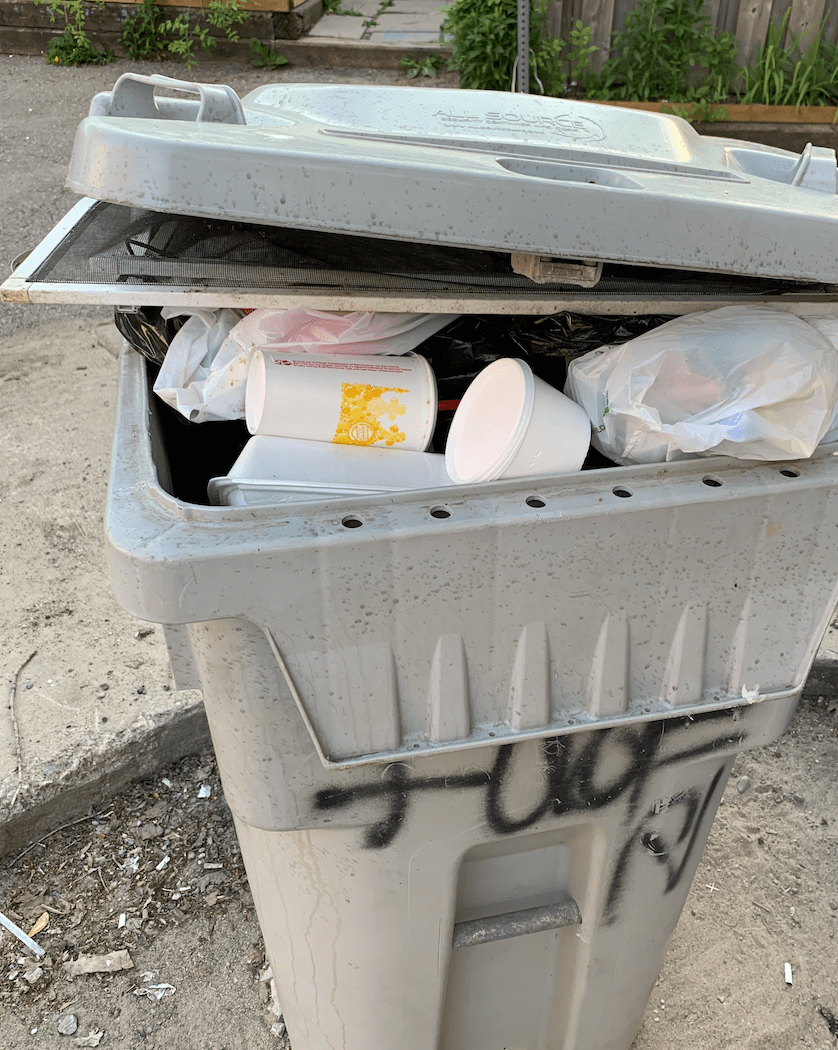
EPS packaging foams in untied recycling bags and overflowing bins waiting for collection.
Project Overview
In collaboration with the Ontario Ministry of the Environment, Parks and Conservation we started In Pursuit of Polystyrene – a multi-phase project designed to address the problem of polystyrene foam at the source. Today, we continue this work with Partners in Project Green (a program of the Toronto and Region Conservation Authority) as a pollution prevention project under the Toronto Inner Harbour Floatables Strategy.
2021 – 2023: Phase 1.0 – Determining the source of foam litter in Lake Ontario.
The aim of this project was to determine how much of the foam littering our waterways came from construction and packaging. Through a better understanding of this source, we aimed to inform policies that mitigate construction and packaging foam pollution.
Phase 1.0 Results: Sampling in Toronto and Lake Ontario revealed that greater than 50% of foam litter was sourced from construction applications. There is a need for increased awareness of construction as a major source of foam pollution in the environment and effective mitigation strategies.


Pie chart showing the proportion of foam from construction applications compared to other applications (ie. food and consumer packaging) from beaches bordering Lake Ontario and surface waters in Toronto’s tributaries and Lake Ontario
- Download the full paper.
2024 – present: Phase 2.0 – Informing reduction of litter sourced from construction activities as a source of plastic pollution to Lake Ontario.
The aim of this project is to increase our understanding of plastic use and loss in the construction industry to inform solutions for reducing plastic litter sourced from construction activities.
This project aims to:
- Interview people in the construction sector to learn more about materials used in construction, potential sources of plastic litter to the environment, and their knowledge on the issue of plastic leakage from construction and practices already in place (or that could be in place) to reduce it.
- Create a briefing note of the potential solutions to reduce plastic leakage from construction activities based on conclusions from interviews and literature review.
- Collaborate with the construction sector to pilot solution(s) to quantify their effectiveness.
Phase 2.0 Results:
Learn More about Polystyrene
Expanded polystyrene (EPS) and extruded polystyrene (XPS) are two types of polystyrene foam used for insulation in building walls. EPS foam is a compilation of numerous small polystyrene beads and made up mostly of air. XPS foam is more rigid and dense. Another type of foam, called polyurethane foam, expands when sprayed onto walls and is also a popular option used for building insulation. If these foams are used IN the walls, how do they make their way to our environment?
One route into the environment occurs during the installation of EPS sheets and requires scraping off some of the polystyrene beads, resulting in “polystyrene snow”. Similarly, trimming XPS sheets and spray polyurethane foam to fit wall structures produces small pieces of foam that can be disregarded during post-construction cleaning. Due to its light and airy texture, these foam particles are free to be swept away by runoff or blown via wind – entering freshwater bodies and contributing to plastic pollution.

EPS Insulation boards on houses under renovation (left). Scraping and trimming of boards emit “polystyrene snow” (right), as seen here lining the gutters across the street. This debris can be easily blown by the wind and enters storm basins during rainfall.
Generally, polystyrene foam used in building activities contains chemical flame retardants, while other polystyrene foams do not. By investigating whether foams found in the environment have chemicals, we can identify the foam particles used in insulation and determine what proportion of polystyrene foam litter originates from construction.
How to identify construction foam debris in the environment.


Phase 1.0 was led by Gloria Gao, a graduate from University of Toronto. She holds an Honours BSc, specializing in Ecology and Evolutionary Biology. During her undergraduate, she was a Research Assistant with the Rollinson Lab, and developed an independent research project investigating morphological abnormalities in a population of spotted salamanders in Algonquin Provincial Park. Gloria also volunteered as a Waste Literacy Instructor for our classroom visits.

Phase 2.0 is led by Elizabeth Stanziano, a Master of Environmental Science student focusing in Conservation and Biodiversity at the University of Toronto Scarborough. She has prior experience as an Outreach and Engagement specialist at the U.S. Environmental Protection Agency’s Office of Research and Development. In addition to the In Pursuit of Polystyrene project, she volunteers as an ambassador with the U of T Trash Team.

Phase 2.0 was initiated by Ella Bowen, a third year undergraduate student at the University of Toronto. Ella is majoring in Biodiversity and Conservation Biology, with a double minor in Forest Conservation Science, and Environmental Studies. In addition to the In Pursuit of Polystyrene, she is worked on the U of T Trash Team’s Fighting Floatables in the Toronto Harbour project, targeting pollutants in Lake Ontario along Toronto’s Harbourfront.
For more information, please email Chelsea Rochman or Elizabeth Stanziano.
Phase 1.0 was in collaboration with the Ontario Ministry of the Environment, Conservation and Parks.
Phase 2.0 is supported by Partners in Project Green, a program of Toronto and Region Conservation Authority.

